Shower shoe: Trine students develop prosthetic for Allen County paramedic
May 11, 2026
Share
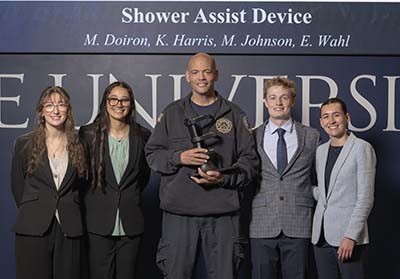
Ben Masten, center, a paramedic for the Northeast Fire District in Allen County, holds
a prosthetic device developed for him by Trine University biomedical engineering students,
from left, Kara Harris, Michaela Doiron, Madix Johnson and Emily Wahl. (Photo by Dean
Orewiler)
Two amputations haven’t stopped Ben Masten from working as a paramedic, but he still
faces challenges every day.
A team of Trine University biomedical engineering majors worked this spring to help
him overcome one of them.
The senior design team of Michaela Doiron of Zachary, Louisiana, Kara Harris of Louisville,
Tennessee, Madix Johnson of New Palestine, Indiana, and Emily Wahl of Defiance, Ohio,
worked with Masten to develop a custom prosthetic that will allow him, and possibly
other double amputees, to navigate easier in the shower.
Amputations due to diabetes
Masten, a paramedic for the Northeast Fire District in Allen County, was diagnosed
with Type 1 diabetes at age 13. As is common with those who have the disease, he has
had issues with healing in his feet.
Eight years ago, he cut his right foot while walking on the beach in Florida. That
cut became infected and resulted in the amputation of the foot six weeks later.
In 2024, he tripped over a guide wire and broke a bone in his left foot. The bone
rotated out of place and created a wound that got infected. Eventually, he had to
have his left leg amputated below the knee.
Doctors thought he would not be able to continue in his role as a paramedic.
“Thankfully, I have been able to prove all that wrong, up to this point at least,”
he said.
Though he has been able to continue his work, Masten still faces everyday challenges.
For instance, taking a shower was difficult for Masten due to his limited mobility
without his prosthetics.
When he shared this concern and the idea he had for a “shower shoe” with Marissa Fisher,
his prosthetist at Prevail Prosthetics and Orthotics in Fort Wayne, she knew how he
might get help.
Fisher, a 2021 biomedical engineering graduate from Trine, suggested he connect with
a senior design team at her alma mater.
A project with impact
Seniors in Trine’s Allen School of Engineering and Computing were offered the opportunity
to choose design projects during the first week of the fall semester. Doiron, who
served as team lead, said Masten’s project stood out to her because of its real-world
impact and connection to prosthetics.
“At the beginning of the year, I decided that I wanted to pursue my master’s degree
in orthotics and prosthetics,” she said. “I knew that this would be good practice.
In addition, the company sponsoring this project is the clinic that I started shadowing
at.”
The goal was to create a customized device that allows for controlled rotation and
movement in the wet environment of a shower.
The team began by meeting with Masten online to hear his idea for a solution. They
researched materials, biomechanics and existing prosthetic designs throughout the
fall semester and into the spring to ensure their final solution was safe and functional.
Members developed designs and the team used a weighted selection matrix to choose
which direction to go. Each team member then modeled in CAD and performed finite element
analysis to simulate real-world conditions and help determine what materials would
perform best.
Masten met with the team online a couple times per month throughout the process.
“Michaela would text me and keep me posted on their progress or if the group had questions,”
he said. “They were amazing to work with and very fun. I could tell they really wanted
to create something meaningful for me that would help me in my life.”
Building a shower shoe
“After the fall semester, we had a good idea of the materials we were going to use,
but there was some material-specific testing that needed to be completed to fully
ensure that this device would be safe for the customer,” said Doiron. “We needed to
ensure that the device would not mold or have serious bacterial growth, that the customer
would not slip in the shower when using the device, that the material would not absorb
water over time and possibly degrade and that the material that made the foot part
of the device was strong enough to hold the customer’s weight and more.”
“One of our biggest challenges was working within a limited budget. Even with donated
materials, we had to be strategic, so we relied on 3D printing for the base components.
This allowed us to iterate quickly and create replacements as needed.”
After this testing was completed, the team was able to start the fabrication process.
They began at Prevail Prosthetics and Orthotics, which served as the company sponsor
for the project with Fisher guiding the team. Prevail provided the resources for the
team to form the part that Masten’s residual limb would reside in.
“There were a few meetings at Prevail to talk to them and try on their prototypes,
but there was very little work on my part,” said Masten.
On April 28, the team gave a presentation on their project along with other biomedical
engineering groups, with Masten in attendance. They gave him the final version of
the shoe following the presentation.
“Just seeing the creation process was so cool, but then to be able to see them present
it and see behind the scenes all the hard work they did and they things they thought
about and considered was amazing,” Masten said. “I think they hit a home run!”
He hopes the shower shoe design eventually can be patented and mass produced to help
other amputees.
Working together
Doiron said it was valuable for the team to learn how to work together on a real-world
project and how to work with a customer.
“We learned what it was like to stay in contact with our customer, conduct research
and testing, and work with people from various departments or interests to accomplish
one goal within a certain timeline,” she said.
In addition to the team members, she expressed gratitude to Masten for his encouragement,
to Beau Watson, Ph.D., associate professor and faculty advisor, for his guidance,
and to Prevail and Fisher for providing materials, feedback and ideas.
“We would not have been able to complete this project without her (Fisher’s) help,”
Doiron said.
A digital marketing campaign developed and executed by a team member in Trine University’s Office of Marketing and Communications has been honored among the recipients of the 2026 Circle of Excellence Awards, announced by the Council for Advancement and Support of Education on July 1.
Trine University’s Allen School of Engineering and Computing hosted a seminar by Hideki Arahari, Ph.D., of Basic Research Laboratories at NTT, Inc. in Japan, on Monday, June 29.
Four Trine University mechanical engineering students presented their original research at an international conference focusing on microelectromechanical systems (MEMS) and microsystems technologies.